An exhaustive political and economic investigation into how North Block’s revenue-maximization machinery has alienated India’s urban salaried taxpayers, small merchants, and retail investors—and why an urgent change at the helm of the Finance Ministry is the ruling party’s only path to political survival in 2029.
The 2029 Red Alert: Why the BJP’s Core Base Is in Open Revolt
In Indian electoral politics, political parties rarely lose power because of their ideological opponents; they lose power when their core base stays home or votes in quiet fury.
The 2024 Lok Sabha election was the first undeniable warning shot. The ruling Bharatiya Janata Party (BJP) saw its absolute parliamentary majority slip from 303 seats down to 240. While political pundits dissected caste coalitions and rural distress, the most glaring, unaddressed undercurrent was the palpable anger, exhaustion, and disillusionment among India’s urban salaried middle class, small shopkeepers, micro-merchants, and retail investors.
For over a decade, this demographic was the ideological and electoral backbone of the Modi government. They cheered structural reforms, endured demonetization, migrated en masse to digital payments, and loyally paid direct taxes while receiving almost zero social safety nets in return.
Yet, under Finance Minister Nirmala Sitharaman, this very base has been treated not as nation-builders, but as a captive milking cow—an easy target to finance bloated state expenditure, welfare handouts, and corporate concessions through stealth cesses, escalating direct levies, and byzantine indirect tax terrorism.
If the BJP enters the 2029 General Election with Nirmala Sitharaman still presiding over North Block, it will be sleepwalking into an electoral catastrophe. The reasons are not ideological; they are arithmetic, economic, and deeply personal to every citizen checking their monthly bank statement.
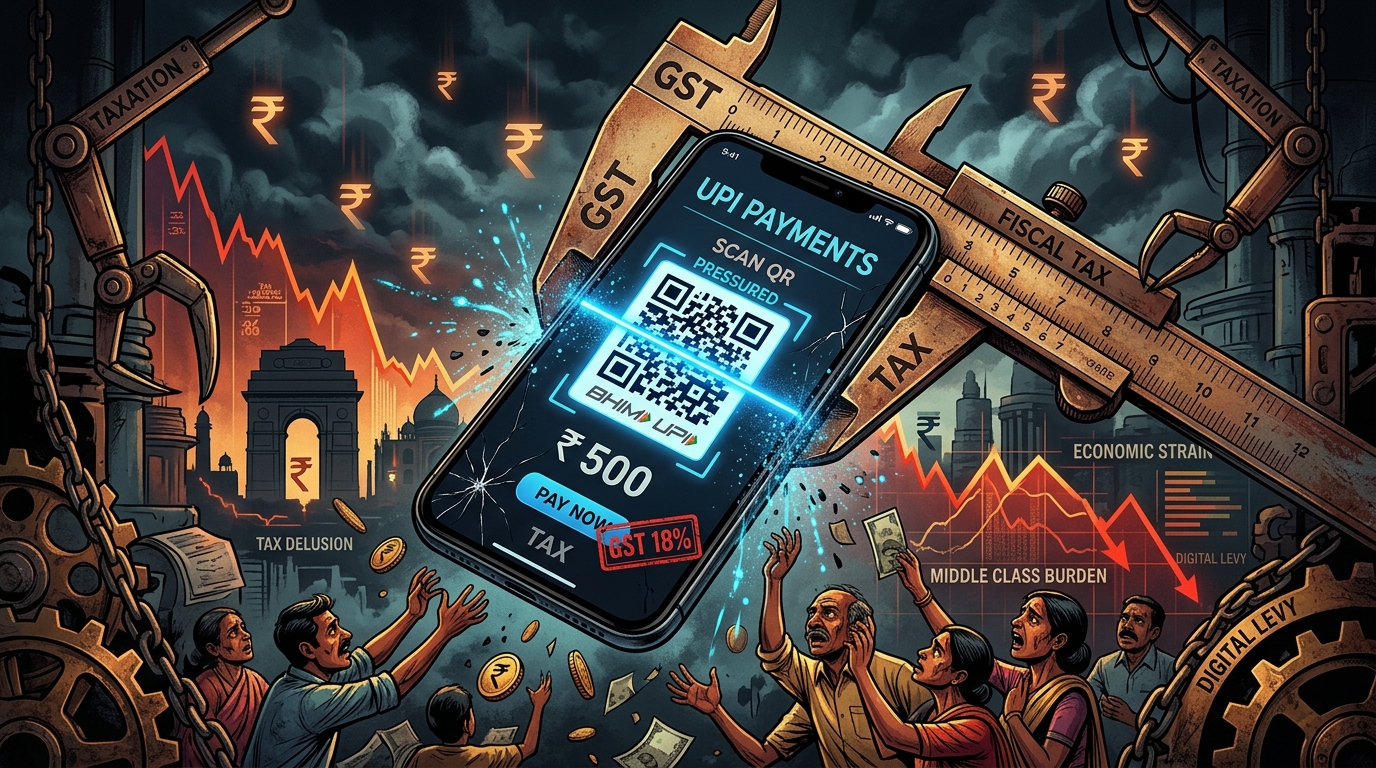
1. The Battle for UPI: The Covert Monetization Play & The Merchant Squeeze
Nothing symbolizes modern India’s technological pride quite like the Unified Payments Interface (UPI). Developed by the National Payments Corporation of India (NPCI), UPI transformed street vendors, small tea stalls, and million-rupee businesses alike into a frictionless, cashless economy. The government built its entire international diplomacy and domestic narrative around this digital triumph.
The foundational social contract of UPI was simple: Zero transaction costs for peer-to-peer (P2P) and peer-to-merchant (P2M) payments.
The Narrative Trial Balloons
Over the last three years, however, the Finance Ministry and its associated regulatory bodies have repeatedly tested the waters to break this contract:
- The RBI Discussion Paper on Payment Charges: Raising the question of whether UPI transactions should carry a tiered fee structure based on transaction amount.
- The 1.1% Interchange Levy on PPI Wallets: While marketed as applying only to prepaid wallets on transactions over ₹2,000, it established the dangerous regulatory precedent of carving out fees on merchant QR transactions.
- Continuous Rumors of Reintroducing MDR (Merchant Discount Rate): The constant push from banking lobbies and North Block bureaucrats to levy 0.3% to 0.75% MDR on merchant UPI transactions.
The Big Lie: “The Customer Won’t Pay, Only the Merchant Will”
Whenever public backlash erupts, the government hastily issues scripted clarifications stating that “UPI remains free for normal users and ordinary citizens.”
This is an economic fraud. Anyone who understands retail economics knows that a tax on the merchant is automatically a tax on the consumer:
[ Government / NPCI / Banks ]
             │ (Levies 0.5% - 1.1% MDR / Interchange)
             ▼
[ Small Shopkeeper / Chaiwala / Kirana ]  ◄── (Operating on 2% to 4% Net Profit Margins)
             │
             ├─► Option A: Increases prices of all items by 2% to 5%
             ├─► Option B: Refuses UPI for bills below ₹100 – ₹200
             └─► Option C: Adds a "2% Card/Digital Surcharge" at checkout
             │
             ▼
      [ Common Consumer Pays the Bill ]
Small merchants running neighborhood kirana stores or food stalls operate on paper-thin net margins. If a merchant is forced to surrender 1% to banks on every QR scan, they cannot absorb that loss. They will either hike shelf prices across the board or revert back to untaxed cash—undoing a decade of digital formalization.
The Finance Ministry’s obsession with turning a Digital Public Good into a Profit Center reveals an extractive mindset: building a world-class highway, waiting until everyone sells their bullock carts, and then erecting toll plazas at every 500 meters.
2. The Micro-Taxation Absurdity: From Caramel Popcorn to Health Insurance
Under Nirmala Sitharaman’s leadership of the GST Council, India’s indirect tax architecture has devolved into a laughing stock of hyper-classification and administrative harassment.
Instead of the promised “One Nation, One Tax” with a clean, low, 2-tier structure, Indian citizens are subjected to a bizarre labyrinth of 0%, 5%, 12%, 18%, and 28% slabs, punctuated by compensatory cesses.
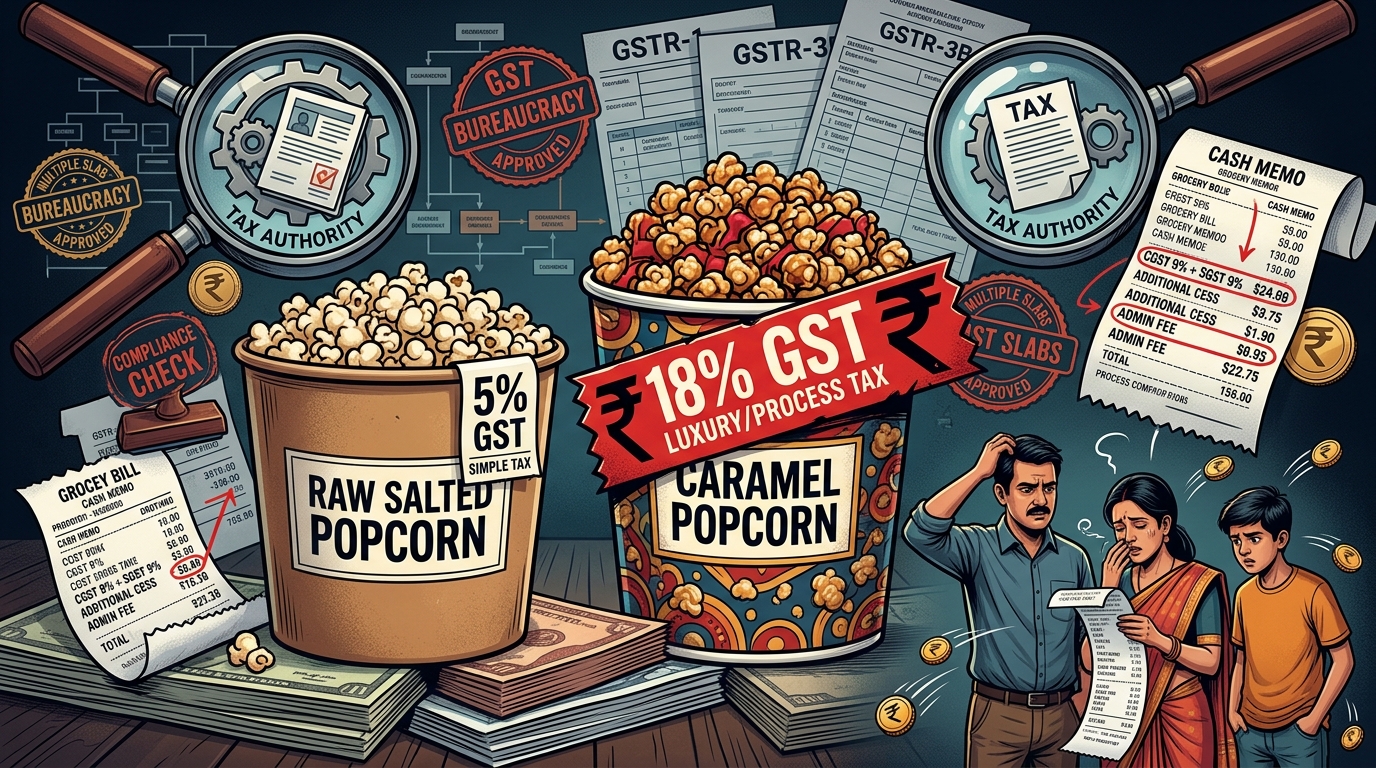
The Popcorn, Parotta, and Paneer Chronicles
Consider the absurd legal battles fought by tax commissioners while the real economy struggled:
| Item / Dispute | Tax Ruling | Bureaucratic Rationale | Real-World Impact |
|---|---|---|---|
| Raw Salted Popcorn | 5% GST | Treated as simple prepared corn grain | Affordable snack |
| Caramel Popcorn | 18% GST | Deemed a “manufactured confectionery / sugar preparation” | Moviegoers & children pay luxury-tier penalties |
| Roti (Wheat Flatbread) | 5% GST | Essential staple food | Consumed by masses |
| Malabar Parotta | 18% GST | Declared “not a roti because it requires heating before eating” | Southern culinary staples penalized by North Block |
| Loose Unbranded Curd | 0% GST | Agricultural produce | Encourages unhygienic, unorganized supply chains |
| Pre-Packaged / Labelled Curd | 5% GST | Processed commodity | Punishes hygiene, standard packaging, and food safety |
| Life & Health Insurance | 18% GST | Categorized alongside luxury entertainment services | Millions penalized for seeking private healthcare |
The Inhuman 18% Tax on Life & Health Insurance
Perhaps no single policy illustrates the moral bankruptcy of North Block more than the 18% GST levied on health and term life insurance premiums.
In a country where:
- Public healthcare hospitals are overcrowded and underfunded;
- Millions of families are plunged into catastrophic poverty every year due to out-of-pocket medical emergencies;
- There is no universal state-funded health security;
The Finance Ministry collects tens of thousands of crores annually by taxing citizens who take personal responsibility to insure their families! When veteran politicians across party lines (including Union Minister Nitin Gadkari) urged the rollback of this 18% levy, the Finance Ministry deflected, dragged its feet, and referred the matter to yet another bureaucratic Group of Ministers (GoM).
3. The Retail Wealth Massacre: LTCG, STCG, and Trading Tax Squeezes
For decades, the Indian middle class had only two avenues to protect their hard-earned money from real-world 8-10% inflation: Real Estate and Fixed Deposits.
When real estate became unaffordable and bank FD interest rates dropped below real inflation (while being taxed at peak slab rates), over 10 crore retail investors entered the Indian equity market through Systematic Investment Plans (SIPs), mutual funds, and direct stock ownership.
The Modi government rightly celebrated the rise of the domestic retail investor as the shield that protected Dalal Street from foreign portfolio outflows.
The Budget 2024 Betrayal
And how were these 10 crore middle-class investors rewarded? With a punitive tax raid:
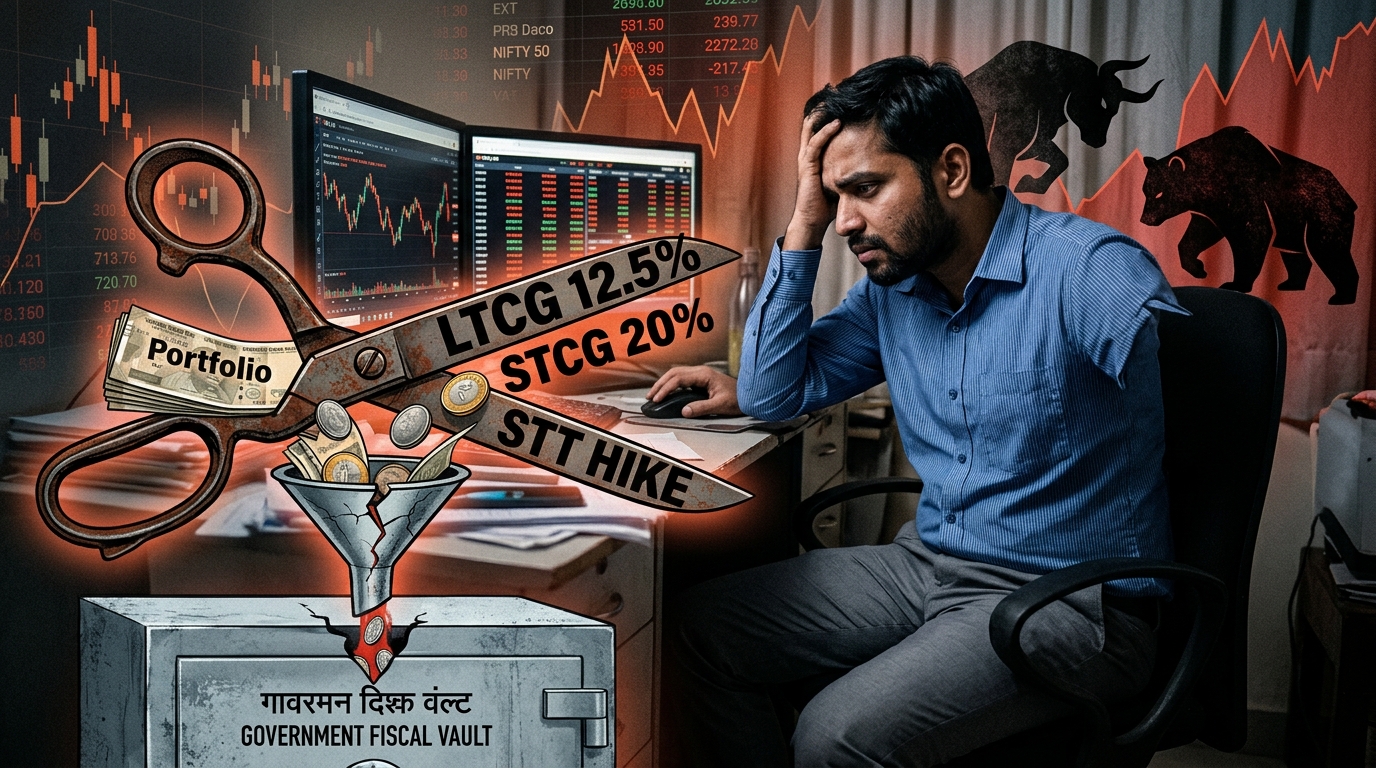
- Long-Term Capital Gains (LTCG) Hike: Increased from 10% to 12.5% on equities, while simultaneously attempting to strip indexation benefits on real estate (which caused such nationwide uproar that the government was forced into a humiliating partial rollback).
- Short-Term Capital Gains (STCG) Hike: Slashed retail risk-taking by jumping from 15% to 20%.
- Securities Transaction Tax (STT) Hike on Futures & Options: Doubled and tripled under the paternalistic excuse that “retail investors must be protected from gambling.”
- Buyback Tax Transferred to Shareholders: Corporate share buybacks, previously taxed at the company level, were slapped directly onto the investor as ordinary dividend income at slab rates (up to 39%!).
The Great Distortion: Individual Income Tax vs. Corporate Tax
Look at the official data from the Controller General of Accounts (CGA) and the Union Budget documents. The trend is staggering:
Year 2018-19:
  Corporate Tax Collection:  ████████████████████ (Higher)
  Personal Income Tax:       ██████████████

Year 2024-26:
  Corporate Tax Collection:  ████████████████ (Slashed to 22%/15%)
  Personal Income Tax:       ████████████████████████ (Surpassed Corporate Tax!)
In 2019, Nirmala Sitharaman slashed corporate tax rates from 30% to 22% (and 15% for new manufacturing units)—a historic giveaway totaling over ₹1.5 lakh crore per year, on the promise that corporations would unleash massive private capital expenditure (capex) and create millions of jobs.
Instead, corporations used the tax windfall to deleverage their balance sheets, buy back shares, and sit on cash reserves. Private capex remained stubbornly stagnant.
To fill the massive fiscal hole created by the corporate tax cut, North Block turned its guns on salaried employees and indirect consumers. Today, individual income tax collections exceed corporate tax collections in India. A salaried engineer or schoolteacher pays a higher effective tax rate on their incremental earnings than a multi-billion-rupee conglomerate!
4. The Free-Falling Rupee and the Soundbite Economics
Under Nirmala Sitharaman’s tenure, the Indian Rupee (INR) has broken one psychological floor after another against the US Dollar—sliding past 70, 75, 80, 83, and beyond 84–85.
While global macroeconomic headwinds and interest rate differentials play a legitimate role in currency movements, the Finance Minister’s communication strategy has turned a serious economic challenge into public mockery.
“The Rupee Is Not Weakening; The Dollar Is Strengthening”
When questioned in Parliament and press conferences about the currency’s relentless depreciation, the Finance Minister famously declared:
“The Indian Rupee has not weakened. It is the US Dollar that is strengthening against all global currencies.”
This statement became an instant viral meme, but the real-world consequences are devastating for common households:
- Imported Inflation: India imports over 85% of its crude oil and almost all electronic hardware, semiconductors, and specialized medical machinery. A weak rupee makes every single import more expensive, directly fueling domestic inflation.
- Higher Education Dreams Smashed: Millions of middle-class families who took education loans to send their children abroad saw their semester fees, living costs, and debt burdens surge by 25% to 35% purely due to currency loss.
- Foreign Travel & Remittance Penalties: Instead of stabilizing the currency, the ministry slapped a punitive 20% Tax Collected at Source (TCS) on foreign remittances and Liberalised Remittance Scheme (LRS) transactions!
5. The Illusion of the New Tax Regime: Eliminating the Culture of Savings
For generations, India’s middle class was built on the ethos of prudent domestic savings. The old income tax regime incentivized this through targeted deductions:
- Section 80C: PPF, EPF, ELSS, Life Insurance, Children’s Tuition Fees;
- Section 80D: Health Insurance;
- Section 24(b): Home Loan Interest Deductions for first-time home buyers;
- NPS 80CCD(1B): Retirement pensions.
The Bureaucratic Trap of the “New Tax Regime”
The Finance Ministry has aggressively nudged taxpayers into the New Tax Regime by making the old regime unviable and offering minor slab tweaks without any deductions.
What is the actual consequence of this policy?
- Destruction of Household Financial Savings: Household net financial savings in India plunged to a five-decade low of ~5.1% to 5.3% of GDP. Without tax incentives, young salaried professionals are stopping term insurance policies, PPF contributions, and ELSS investments.
- Punishing the Homebuyer: By removing home loan interest deductions in the default regime, the dream of owning a modest residential flat has become substantially more expensive for first-time buyers.
- A Nation of Consumption-Taxed Drones: The goal of the ministry appears to be simple: eliminate deductions, tax income at source, and then tax every rupee of expenditure through 18% GST and fuel cesses when the citizen spends it.
6. Political Analysis: Why Nirmala Sitharaman Is the Opposition’s Greatest Asset
Why is this an existential crisis for the BJP’s 2029 campaign?
1. The Death of the “Modi Reformist” Economic Coalition
In 2014, Narendra Modi was propelled to power by an aspirational coalition that believed the BJP stood for minimum government, maximum governance, low taxes, deregulation, and honoring honest wealth creators.
Ten years later, the economic face of the government has become associated with:
- Tax Notice Raj: Over 10 crore automated scrutiny and reassessment notices sent to taxpayers dating back 6–10 years.
- Bureaucratic Arrogance: Dismissive responses to industry leaders, chartered accountants, and ordinary citizens raising legitimate pain points on GST portals, income tax bugs, and compliance overreach.
- Stealth Fuel Cesses: Maintaining sky-high excise duties and special additional excise duties on petrol and diesel even when international Brent crude crashed, pocketing the surplus into government coffers rather than passing relief to consumers.
2. The Alienation of the Urban Electoral Core
In 2024, the BJP suffered notable margin drops and defeats in major urban and semi-urban constituencies across Maharashtra, Uttar Pradesh, Haryana, and Karnataka.
Urban voters do not receive free rations, free electricity, or agricultural PM-KISAN payouts. Their only connection to governance is:
- The quality of roads, water, and air (which remain abysmal in most Indian metros);
- The purchasing power of their monthly salary;
- The stability of their investments.
When a government takes 30% of their income, 18% of their consumption, 12.5% of their capital gains, and 28% on their automobiles, and gives back potholes, paper leaks, and bureaucratic arrogance, voter turnout collapses.
7. Policy Comparison Scorecard: Promise vs. Nirmala Sitharaman’s Reality
| Economic Domain | 2014 / 2019 BJP Vision Promise | Nirmala Sitharaman Ministry Ground Reality | Middle Class Verdict |
|---|---|---|---|
| Digital Payments (UPI) | Free, frictionless, public digital infrastructure for all Indians. | Constant trial balloons to levy MDR, 1.1% interchange fees, and monetize merchant QR codes. | Extractive |
| Direct Income Tax | Simplified, lower tax rates to reward honest salaried taxpayers. | Corporate taxes slashed, but personal income taxes surpass corporate revenue; savings incentives dismantled. | Severe Burden |
| Capital Markets | Encourage equity culture and domestic retail participation to build wealth. | Slashed indexation, hiked LTCG (12.5%), STCG (20%), STT, and buyback taxes on retail investors. | Punitive |
| GST Architecture | One Nation, One Tax; simple 2-slab system to reduce compliance. | 5+ slabs, 18% on health insurance, bizarre litigation on caramel popcorn and parottas. | Tax Terrorism |
| Currency & Imports | A strong, stable Indian Rupee reflecting India’s growing economic power. | INR down to historic lows (84-85+ vs USD); dismissed with “the Dollar is strengthening”. | Failure |
| Fuel & Inflation | Lower fuel prices when global crude prices drop. | Refused to pass crude drops; absorbed surplus via special unshared Central cesses. | Profiteering |
8. What the BJP Leadership Must Do Before It Is Too Late
If Prime Minister Narendra Modi and the BJP leadership want to avert an urban middle-class revolt in the upcoming state elections and secure a commanding mandate in 2029, cosmetic cabinet reshuffles will not suffice. There must be a decisive structural pivot in economic leadership:
- Replace the Finance Minister with a Pro-Growth, Pro-Middle Class Reformer: North Block needs a leader with real-world market understanding and empathy for the taxpayer—not an extractive bureaucrat-driven approach that measures success solely by tax collection targets.
- Permanently Enshrine Zero-Cost UPI: Issue a binding, unambiguous statutory guarantee that UPI transactions—for both consumers and merchants—will forever remain zero-MDR, zero-fee public infrastructure.
- Roll Back the LTCG & STCG Hikes: Restore long-term capital gains tax to a flat 10% (or provide complete exemption for long-term investments held beyond 3 years) and restore real estate indexation.
- Immediate GST Overhaul:
- Abolish the 18% GST on Health and Term Life Insurance immediately.
- Collapse the absurd 5-tier GST labyrinth into 3 clear slabs (0%, 8%, 18%).
- End frivolous classification disputes over snacks, food staples, and basic necessities.
- Restore Tax Incentives for Household Savings: Provide substantial deductions under the direct tax code for long-term health, retirement, and home purchase investments.
The Bottom Line
The common man in India does not demand impossible doles or state charity. The Indian middle class asks only for one thing: the right to breathe, the right to save, and the right to build a future for their children without the state dipping its fingers into every pocket at every step.
Nirmala Sitharaman’s economic tenure has transformed the Finance Ministry into an insatiable revenue-extraction machine that treats citizen prosperity as an untapped taxable surplus.
For the BJP, the political arithmetic of 2029 is crystal clear:
You cannot win a national mandate while waging an unceasing economic war on the very people who put you in power.
The time for cosmetic press briefings and dismissive soundbites has expired. To survive 2029, the BJP must listen to the streets, fire Nirmala Sitharaman, and restore faith in the Indian middle class.
Special Political & Economic Desk
16 September 2026
Document References & Primary Data Sources
- 📄 RBI Discussion Paper on Charges in Payment Systems (Official PDF)
- 📄 National Payments Corporation of India (NPCI) — Circular on Interchange Guidelines
- 🔗 Union Budget Documents — Finance Bill Direct Tax & Capital Gains Amendments
- 🔗 Controller General of Accounts (CGA) — Monthly Union Financial Reports
- 🔗 GST Council Secretariat — Notifications on Food Classifications & Rates
Reader Perspectives