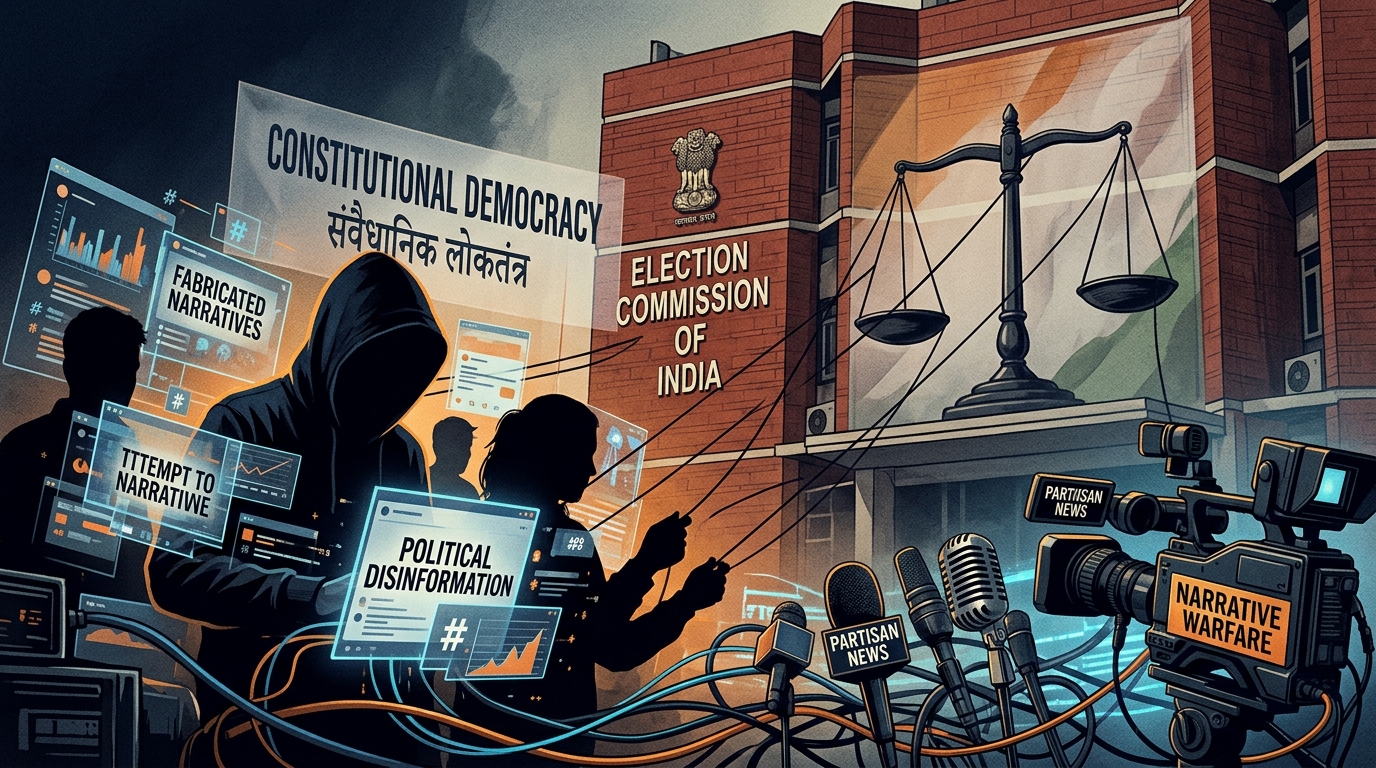
An investigative editorial by DIMAGINAXALITE analyzing the ongoing narrative offensive against India’s constitutional election architecture, the weaponization of fringe agitations, school trespass incidents, partisan media proxies, and the state’s inexplicable reluctance to enforce statutory law against unelected narrative syndicates.
Executive Summary: The Delegitimization Playbook
In constitutional democracies, the bedrock of stability is not the absence of political competition, but the universal acceptance of the referee’s legitimacy. When political factions lose faith in their ability to persuade voters, their strategic objective shifts from winning elections to destroying public confidence in the electoral mechanism itself.
Over the past three election cycles, India has witnessed a synchronized, multi-tiered narrative campaign designed to erode the authority of the Election Commission of India (ECI) and Chief Election Commissioner Gyanesh Kumar. What is presented to the public as “grassroots civic activism” or “investigative journalism” is, upon forensic examination, a structured political syndicate operating across legal, digital, and media corridors.
                    ┌────────────────────────────────────────────────────────┐
                    │       THE FIVE-STAGE INSTITUTIONAL ATTACK CYCLE       │
                    └────────────────────────────────────────────────────────┘
                                                 │
          ┌───────────────────────┬──────────────┴──────────────┬───────────────────────┐
          ▼                       ▼                             ▼                       ▼
    ┌───────────┐           ┌───────────┐                 ┌───────────┐           ┌───────────┐
    │ 1. SEED   │           │ 2. STREET │                 │ 3. MEDIA  │           │ 4. LEGAL  │
    │  DOUBT    │ ────────> │ AGITATION │ ──────────────> │ PROXIES   │ ────────> │ MONETIZE  │
    └───────────┘           └───────────┘                 └───────────┘           └───────────┘
    • Unsubstantiated       • School & campus             • Soft-ball             • Public interest
      EVM / Roll              trespass                      interviews              litigation (PIL)
      allegations           • Manufactured clashes          • Selective framing     • Donation drives
This report investigates:
- The Strategic Assault on CEC Gyanesh Kumar: Why constitutional officers are personalized as partisan targets.
- The Illegal School Trespass Phenomenon: How activist influencers crossed legal boundaries by invading educational spaces.
- The Media Syndicate & Narrative Laundering: How mainstream platforms and digital anchors act as soft-power amplifiers for radical agendas.
- The Ground Reality vs. Manufactured Panic: Why everyday citizens and students reject the apocalyptic narrative.
- The Unforgivable Passivity of the Government: Why the state’s hesitation to prosecute illegal agitprop invites constitutional subversion.
1. Targeting CEC Gyanesh Kumar: Why the ECI Must Be Delegitimized
The attack on Chief Election Commissioner Gyanesh Kumar is neither spontaneous nor accidental. It is the continuation of a well-documented doctrine: if you cannot win within the constitutional framework, declare the framework rigged.
Under Article 324 of the Constitution, the Election Commission possesses independent, quasi-judicial superintendence over elections. For over seven decades, through smooth power transitions spanning fourteen Prime Ministers and hundreds of state elections, the ECI has remained India’s most trusted democratic institution.
Yet, whenever state or general election outcomes reject specific ideological formations, the narrative switches instantly:
- The EVM Myth Re-packaged: Despite 40+ high court and Supreme Court judgments affirming EVM integrity and 100% VVPAT slip matching audits, narrative cells continue to publish speculative claims to sow electoral paranoia.
- The Personalization Strategy: Instead of challenging procedural rules via established statutory mechanisms, activist groups like Citizens for Justice and Peace (CJP) and allied networks launch ad hominem attacks against individual commissioners, painting senior civil servants as partisan operatives.
- International Narrative Export: Local allegations are rapidly packaged into op-eds for foreign publications, aiming to downgrade India’s democratic ranking in Western advocacy indices.
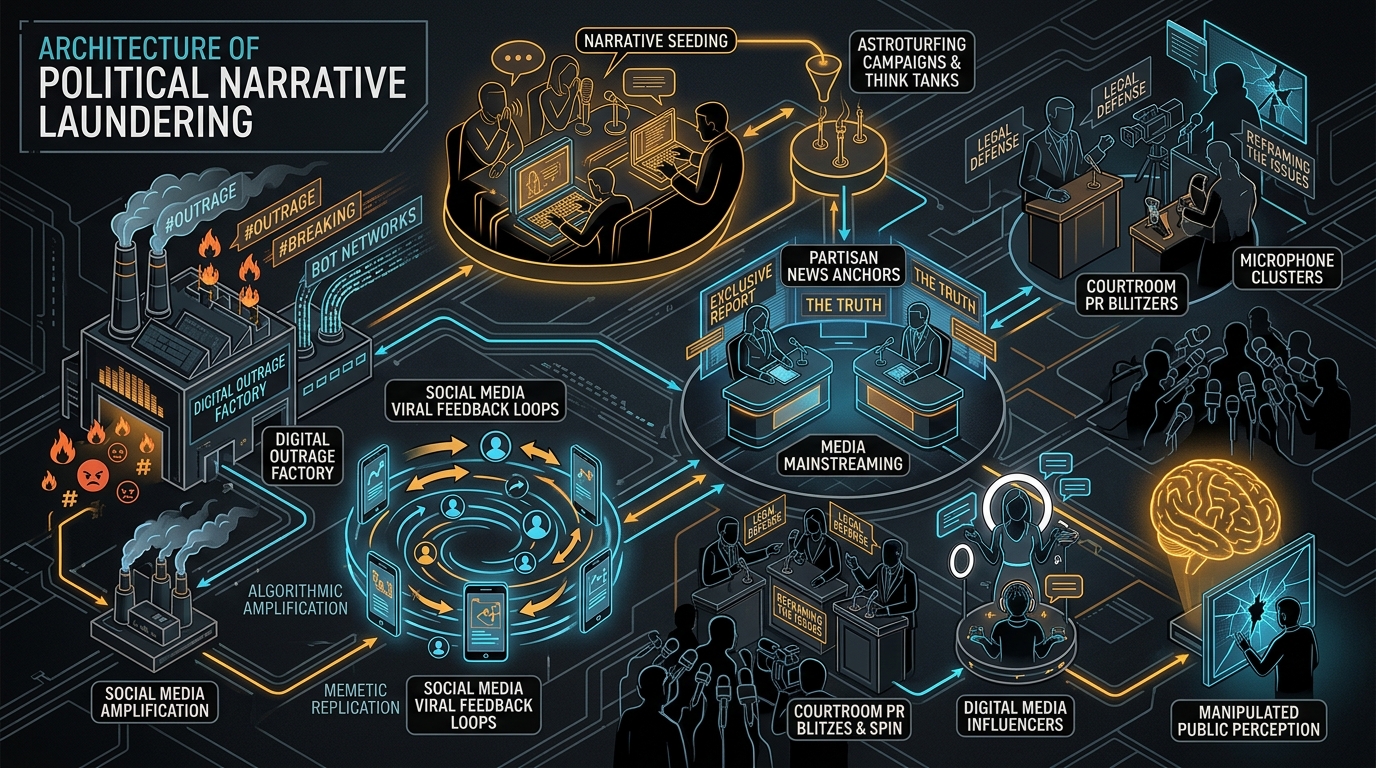 Figure 1: Forensic map showing the flow of narrative laundering between digital outrage factories, proxy news anchors, courtroom PR cells, and manufactured public perception.
2. Crossing the Red Line: Illegal School Trespass & Child Exploitation
A particularly alarming escalation in recent months has been the direct targeting of schools, colleges, and minors by self-styled “independent journalists” and activist agitators.
Under the guise of “investigating education quality” or “seeking student voices,” content creators and activist cadres have repeatedly entered school premises without statutory authorization, interrogating teachers and recording minor students without parental consent.
The Legal Reality of Educational Trespass
| Statutory Framework | Statutory Provision | Violation by Activist Influencers |
|---|---|---|
| Bharatiya Nyaya Sanhita (BNS) / IPC | Criminal Trespass & Public Nuisance | Entering educational institutions without administration approval to film sensational content. |
| Juvenile Justice (Care & Protection) Act | Protection of Minor Identity | Broadcasting unconsented video footage of minor schoolchildren for political monetization. |
| Right to Education (RTE) Mandates | Uninterrupted Academic Environment | Disrupting classroom hours and intimidating government school teachers on camera. |
These are not journalistic inquiries; they are deliberate provocations designed to manufacture viral conflict clips, trigger administrative overreaction, and then play the victim card across social media.
3. The Proxy Media Syndicate: From Jantar Mantar to Courtroom PR
The political ecosystem does not operate in isolation. It relies on a symbiotic transmission belt connecting digital influencers, legacy journalists, courtroom lawyers, and political veterans.
┌─────────────────────────────────────────────────────────────────────────────────┐
│                      THE MEDIA LAUNDERING TRANSMISSION BELT                     │
├─────────────────────────────────────────────────────────────────────────────────┤
│                                                                                 │
│  [ Street Activist / CJP Agitator ]                                             │
│               │ (Stages provocative stunt / school trespass / Jantar Mantar)    │
│               ▼                                                                 │
│  [ Digital Influencer / Youtuber ] ──> Uses hyper-emotional, anti-institution   │
│               │                        framing to monetize grievance on YouTube │
│               ▼                                                                 │
│  [ Legacy News Platforms & Anchors ] ─> e.g. Indian Express op-eds & Lallantop   │
│               │                        interviews frame the stunt as a 'heroic  │
│               │                        struggle against authoritarianism'       │
│               ▼                                                                 │
│  [ Courtroom PR Syndicate ] ──────────> Kapil Sibal & allied lawyers file PILs, │
│                                        converting viral social media hysteria   │
│                                        into courtroom spectacle                 │
└─────────────────────────────────────────────────────────────────────────────────┘
The Anatomy of Soft-Glove Normalization
Consider how major media portals and digital shows handle these controversies:
- The “Neutral Observer” Charade: When platforms like The Lallantop (hosted by Saurabh Dwivedi) or legacy dailies cover street mobilizations at Jantar Mantar, activist leaders are given sympathetic, unchallenged platforms to castigate constitutional bodies, while counter-evidence, statutory norms, and institutional clarifications are minimized or omitted.
- The Sibal-Activist Nexus: Senior advocates like Kapil Sibal routinely translate social media outrage into Supreme Court petitions. When the court dismisses frivolous challenges with costs, the dismissal itself is laundered as proof that “institutions have collapsed.”
- Algorithmic Astroturfing: Within minutes of an activist tweet, bot armies and syndicated WhatsApp/Telegram channels push trending hashtags (#SaveDemocracy, #TargetECI), creating the false illusion of a national mass movement.
4. The Citizen’s Reality: Fairness vs. Manufactured Rage
While digital echo chambers depict an institutional apocalypse, ordinary Indian citizens, students, and voters experience a vastly different reality.
- Streamlined Citizen Services: From automated voter ID updates to transparent electoral roll revisions, the Election Commission’s digital platforms (such as the Voter Helpline app and ERONET) offer unprecedented accessibility.
- Unprecedented Voter Turnout: Across Jammu & Kashmir, Haryana, Maharashtra, and Jharkhand, historic voter participation among youth and women directly refutes the claim that citizens distrust the electoral process.
- Campus Clarity: In university elections (such as the DUSU results), Gen-Z students overwhelmingly rejected ideological disruption in favor of tangible campus welfare, governance, and national interest.
The dissonance between online activist rage and offline public confidence highlights a fundamental truth: the activist ecosystem does not represent India; it represents a displaced elite furious that its monopoly over power has been broken.
5. The State’s Fatal Weakness: Why Government Passivity Is an Accomplice
While activist groups bear moral and political responsibility for their disinformation campaigns, the ultimate constitutional blame rests on a passive, hesitant administration.
For years, the Union Government and law enforcement agencies have treated radical narrative warfare with bureaucratic indifference. Instead of strictly enforcing laws against criminal defamation, unauthorized school trespass, and illegal protest logistics, the state adopts a defensive posture, hoping the controversy will blow over.
Why Passivity Is Dangerous
- Erosion of Deterrence: When unlawful trespassers and narrative agitators face no legal consequences, they are emboldened to target higher constitutional bodies.
- Institutional Demoralization: Civil servants, election officers, and police personnel who uphold the law feel abandoned when the state fails to defend institutional integrity against slander.
- The Trap of False Neutrality: A government that refuses to enforce the law out of fear of negative international headlines ends up losing both its authority and its public credibility.
Editorial Stance: If an elected government cannot protect constitutional referees like the Election Commission from coordinated narrative subversion and illegal street intimidation, it fails its primary constitutional duty. India’s sovereignty cannot be held hostage to the sensitivities of unelected advocacy syndicates.
6. What Needs to Happen: A 4-Point Constitutional Remedy
To safeguard India’s democratic foundations against narrative warfare, decisive statutory action is required:
- Strict Enforcement on Institutional Slander: Establish fast-track judicial proceedings for deliberate, unsubstantiated claims that seek to delegitimize the Election Commission and judicial bodies.
- Zero-Tolerance on Educational Trespass: Mandate non-bailable statutory penalties for unauthorized commercial filming, political agitation, or minor interrogation inside school campuses.
- Financial Transparency for Narrative NGOs: Enforce rigorous audits on domestic and foreign funding streams powering activist litigation factories and viral astroturfing networks.
- Proactive Institutional Communication: The Election Commission must establish a permanent, real-time Counter-Disinformation Bureau to debunk viral falsehoods within hours of dissemination.
Conclusion: India Will Not Be Governed by Outrage
Democracy in India was earned through the sacrifices of millions and is preserved daily by the diligence of its citizens and institutions. It does not belong to activist cliques, courtroom power brokers, or monetization-hungry social media influencers.
The attempt to delegitimize Chief Election Commissioner Gyanesh Kumar and the Election Commission of India is not an exercise in free speech; it is a calculated assault on the democratic franchise itself. It is time for the law to take its course—swiftly, transparently, and unapologetically.
Key Takeaways & Fact Dossier
- Constitutional Independence: The ECI derives its authority directly from Article 324, subject only to the Supreme Court’s judicial review.
- Electoral Integrity: Over 40 million EVM votes audited with VVPAT slips across multiple elections show 100% mathematical accuracy.
- Legal Accountability: Freedom of expression does not confer a license for school trespass, minor exploitation, or unsubstantiated institutional subversion.
Reader Perspectives