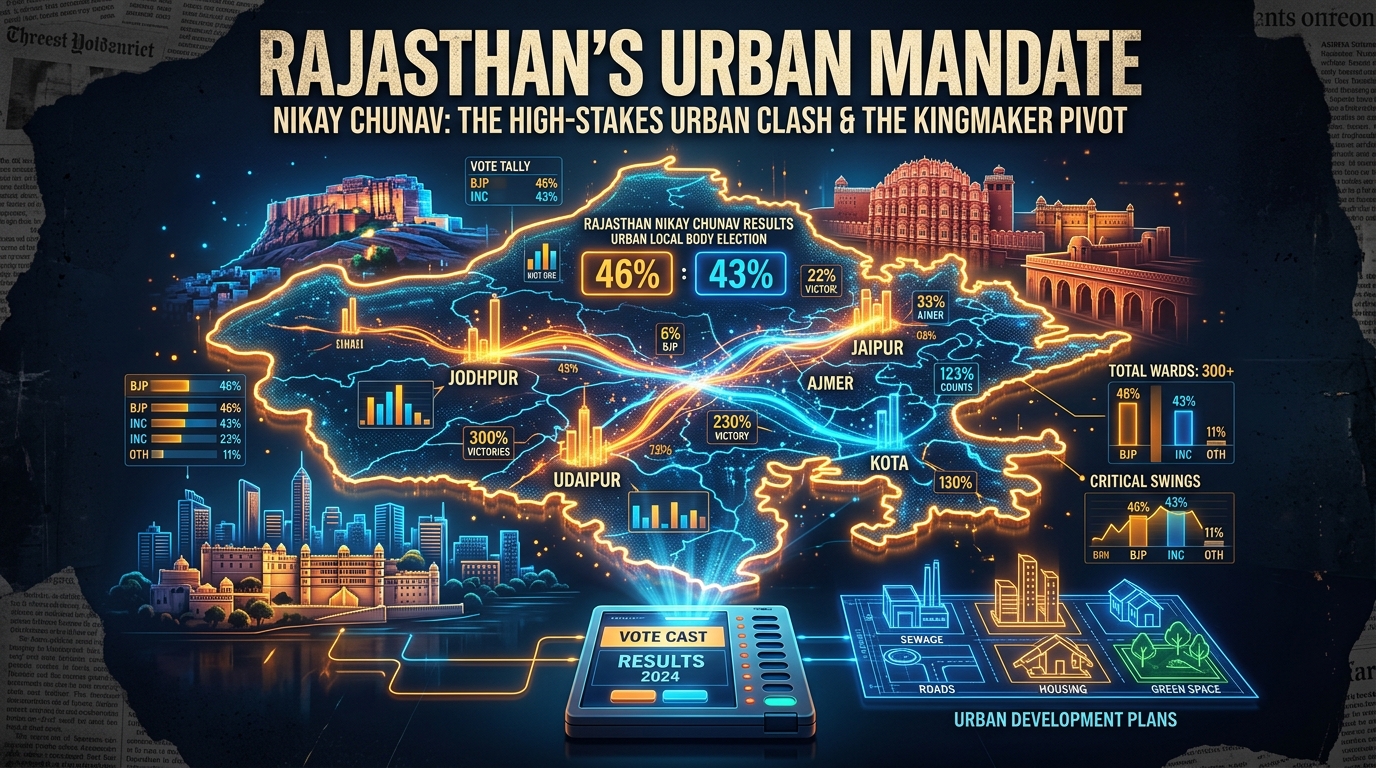
An in-depth investigative dissection of the 2026 Rajasthan Urban Local Body (Nikay Chunav) election results: dissecting the fierce BJP–Congress collision across 309 civic bodies, the voter mindset on civic delivery vs ideological messaging, granular city-by-city breakdowns, and the decisive surge of independent kingmakers.
- The Statewide Picture: Across 309 urban local bodies (ULBs) including 10 Municipal Corporations, 51 Municipal Councils, and 248 Municipalities covering over 7,700 wards, the ruling Bharatiya Janata Party (BJP) secured an overall edge, but the Indian National Congress (INC) mounted a resilient counter-offensive in key strongholds.
- The Battle of Strongholds: BJP consolidated its dominance in Jaipur, Udaipur, and Kota, while Jodhpur witnessed a fierce, photo-finish neck-and-neck confrontation reflecting deep localized polarization.
- The Rise of Independent Kingmakers: Over 1,600 wards were captured by independents and regional candidates. In dozens of municipal councils, neither major party holds a standalone majority, making rebel factions and independent blocs the ultimate power brokers for Mayoral and Board President chairs.
- Public Sentiment Matrix: Voters decisively separated national/state-level ideological issues from hyper-local municipal grievances—prioritizing sanitation, drainage, water distribution, road quality, and building approvals over routine campaign rhetoric.
- The 2028 Horizon: Widely dubbed the "Semi-Final," this election delivers vital diagnostic data for Chief Minister Bhajan Lal Sharma's administrative apparatus and signals warning bells for both camps ahead of future assembly contests.
1. The Big Picture: Urban Rajasthan Goes to the Ballot
The counting of votes across Rajasthan’s 309 Urban Local Bodies (Nikay) marks one of the most consequential grassroots electoral exercises in the state’s recent history. Covering 10 Municipal Corporations (Nagar Nigam), 51 Municipal Councils (Nagar Parishad), and 248 Municipalities (Nagar Palika), this multi-tiered election mobilized millions of urban voters across over 7,700 wards.
                    RAJASTHAN NIKAY CHUNAV 2026: MACRO TALLY SNAPSHOT

┌─────────────────────────────────────────────────────────────────────────────┐
│ TOTAL WARDS CONTESTED: 7,700+  |  309 CIVIC BODIES (10 CORPS, 51 COUNCILS)  │
├───────────────────────┬─────────────────────────┬───────────────────────────┤
│ PARTY / FORMATION     │ WARDS WON / LEADING     │ ESTIMATED SEAT SHARE      │
├───────────────────────┼─────────────────────────┼───────────────────────────┤
│ BJP                   │ 3,100+                  │ ~40.2%                    │
│ INC (Congress)        │ 2,820+                  │ ~36.6%                    │
│ Independents & Others │ 1,780+                  │ ~23.2%                    │
│ (RLP, BAP, AAP, BSP)  │                         │                           │
└───────────────────────┴─────────────────────────┴───────────────────────────┘
While the ruling BJP retains the primary lead in total ward tallies and major corporation mayoral prospects, the gap between the two major parties remains tight. The outcome is far from a one-sided sweep, underscoring a nuanced urban electorate that judges governance on ward-level delivery rather than sweeping political narratives alone.
2. Public Pulse: What Did the Voters Actually Prioritize?
Analyzing ground feedback from election booths, local media interactions, and digital discussions reveals a distinctive split between macro-political posturing and ground-level voter motivation.
                         THE VOTER DECISION MATRIX

  ┌──────────────────────────────────────────────────────────────────────┐
  │ 1. HYPER-LOCAL CIVIC DELIVERY                                        │
  │    • Pothole-free roads, storm water drainage, sewage overflows      │
  │    • Regular municipal water supply and solid waste management       │
  │    • Transparent single-window building permits & property tax ops   │
  ├──────────────────────────────────────────────────────────────────────┤
  │ 2. STATE GOVERNMENT PERFORMANCE CHECK                                │
  │    • Zero tolerance on paper leak cartels & recruitment exams        │
  │    • Law enforcement, policing, and women's safety in urban hubs    │
  │    • Perception of administrative responsiveness under CM Sharma     │
  ├──────────────────────────────────────────────────────────────────────┤
  │ 3. THE REBEL FACTOR & LOCAL ACCESSIBILITY                            │
  │    • Widespread rejection of "parachute" or nepotistic party tickets  │
  │    • Direct reward for accessible, 24/7 grassroots ward workers      │
  │    • Disillusionment with internal factional disputes in both camps   │
  └──────────────────────────────────────────────────────────────────────┘
Key Insights on Public Sentiment:
-
The Double-Engine Dividend vs. Municipal Lethargy: Voters in rapidly expanding urban centers like Jaipur, Udaipur, and Kota favored the BJP’s promise of synchronizing central urban infrastructure funds (Smart Cities Mission, AMRUT 2.0, PM Awas Urban) with state administrative machinery. However, where municipal corporations failed to address recurring waterlogging and waste management, voters punished sitting councilors regardless of party symbols.
-
The “Accessible Candidate” Trumps Party Symbol: In small and medium municipalities (Nagar Palikas), party flags took a back seat to individual accessibility. A candidate who answered phone calls at 2:00 AM for hospital admissions, water tanker shortages, or ration disputes often defeated official candidates backed by heavy party machinery.
-
Youth & Employment Undercurrents: In tier-2 education hubs like Kota, Sikar, and Jodhpur, youth voters were intensely vocal regarding transparent recruitment exams, coaching infrastructure regulation, and job opportunities. The state government’s aggressive crackdown on recruitment paper leaks received positive marks, but the demand for rapid job creation remained a persistent theme.
3. Granular Location-by-Location Analysis
                    REGIONAL CORRIDOR PERFORMANCE MATRIX

┌──────────────┬──────────────────┬─────────────────┬─────────────────────────┐
│ REGION / HUB │ DOMINANT FORCE   │ RUNNER-UP       │ CRITICAL DECIDING FACTOR│
├──────────────┼──────────────────┼─────────────────┼─────────────────────────┤
│ Jaipur       │ BJP (Strong)     │ INC             │ Metro expansion, civic  │
│ Jodhpur      │ INC / BJP (Tie)  │ Photo Finish    │ Gehlot bastion legacy   │
│ Kota         │ BJP (Slight Lead)│ INC             │ Riverfront vs Drainage  │
│ Udaipur      │ BJP (Clear)      │ INC             │ Tourism & Heritage grid │
│ Ajmer        │ Independents/BJP │ INC             │ Smart City audit anger  │
│ Bikaner      │ BJP              │ INC / Ind.      │ Water infra & trade hub │
│ Bharatpur    │ Independents/INC │ BJP             │ Eastern Rajasthan caste │
└──────────────┴──────────────────┴─────────────────┴─────────────────────────┘
A. Jaipur (Heritage & Greater): The Capital Stronghold
In the state capital, the split corporation architecture (Heritage and Greater) witnessed high-stakes mobilization:
- Jaipur Greater: The BJP maintained its traditional dominance across the suburban and newly developed sectors (Malviya Nagar, Mansarovar, Sanganer, Vidyadhar Nagar), banking on urban trader consolidation and infrastructure development.
- Jaipur Heritage: The historic Walled City and surrounding demographic clusters saw a fierce, trench-by-trench battle between Congress and BJP, with Congress leveraging community ties and minority concentrations while BJP gained traction on civic regulation and anti-encroachment drives.
B. Jodhpur (North & South): The High-Stakes Battleground
As the home turf of former Chief Minister Ashok Gehlot, Jodhpur emerged as the most intensely contested municipal arena:
- The Neck-and-Neck Duel: Jodhpur North saw Congress putting up a resolute front, leaning on decades-old local patronage networks and welfare memory.
- Jodhpur South: BJP countered strongly with appeals to middle-class urban stability and industrial growth in surrounding zones. The razor-thin margins in multiple wards prove that Marwar remains an unpredictable political cockpit.
C. Kota (North & South): The Coaching Capital’s Verdict
Kota’s contest pitted the legacy of heavyweight urban development projects against localized discontent:
- While former minister Shanti Dhariwal’s massive infrastructure projects (Chambal Riverfront, signal-free traffic flyovers) formed the bedrock of Congress campaign messaging, BJP highlighted exorbitant project maintenance costs, neglected outer wards, and distress in the coaching hostel economy.
- The result is a fractured verdict where BJP leads in aggregate ward numbers, but Congress retains significant pockets in older city quarters.
D. Udaipur & Mewar: The Saffron Bastion Holds
In southern Rajasthan, Udaipur and adjoining civic bodies demonstrated robust consolidation for the BJP:
- The party capitalized on tourism infrastructure revival, smart municipal monitoring, and deep ideological resonance in the Mewar-Vagad belt.
- While the Bharat Adivasi Party (BAP) made notable inroads in rural and peri-urban tribal fringes, the core municipal wards of Udaipur city remained decisively anchored to the BJP.
E. Ajmer, Bharatpur & The Independent Epicenter
In central and eastern Rajasthan, official party machines suffered their heaviest blows from internal rebels and independent candidates:
- In Ajmer, public dissatisfaction with the execution pace of Smart City road diggings and sewage overhauls created a surge in favor of civic activists and rebel councilors.
- In Bharatpur, the traditional interplay of local community alignments and rebel candidates fractured both major party vote banks, leaving the Municipal Council dependent on post-poll bargaining.
4. The Independent Factor: Kingmakers of the Municipal Boards
One of the most striking findings of the 2026 Nikay Chunav is the massive footprint of Independent Candidates, who bagged more than 1,600 wards statewide.
                       HOW REBELS RESHAPED THE TALLY

        [ Party Denies Ticket to Local Ground Worker ]
                              │
                              ▼
        [ Candidate Files Independent Nomination ]
                              │
                              ▼
        [ Direct Voter Outreach & Personal Network ]
                              │
                              ▼
        [ Independent Wins Ward by 100–400 Votes ]
                              │
                              ▼
   ┌──────────────────────────────────────────────────────┐
   │ HUNG CIVIC BODY: BOTH PARTIES COMPELLED TO NEGOTIATE │
   └──────────────────────────────────────────────────────┘
In over 45 Municipal Councils and Municipalities, neither BJP nor Congress crossed the magic halfway mark on their own symbol. The battle for the Mayor (Mahapaur) and Municipal Chairman (Nagar Palika Adhyaksh) posts now enters the stage of intense political maneuvering, where independent councilors hold the decisive key.
5. Trending Search Intelligence: What India is Searching on Google
Online interest around the Rajasthan Nikay Chunav spiked sharply from the early counting hours of September 14, 2026. Real-time Google Trends and search query telemetry provide critical insight into what the public is tracking:
                    TOP SEARCH QUERIES & INTENT VELOCITY

┌──────────────────────────────────────────────┬───────────────┬────────────────┐
│ SEARCH QUERY                                 │ SEARCH VOLUME │ CORE USER GOAL │
├──────────────────────────────────────────────┼───────────────┼────────────────┤
│ "Rajasthan Nikay Chunav Result 2026 Live"     │ Breakout (+450%) │ Real-time tally│
│ "Jaipur Nagar Nigam Result Ward Wise"        │ Very High     │ Ward winners   │
│ "Jodhpur Nikay Chunav Winner List"           │ Very High     │ Seat breakdown │
│ "Rajasthan Municipal Election BJP vs Congress"│ High         │ State comparison│
│ "Kota Nagar Nigam Chunav Result"             │ High          │ Local outcome  │
│ "Bhajan Lal Sharma Local Body Election Test" │ Moderate      │ Political impact│
│ "Independent Candidates Rajasthan Nikay"     │ High (+210%)  │ Kingmaker math │
└──────────────────────────────────────────────┴───────────────┴────────────────┘
Key Themes Dominating Social Media & Digital Discourse:
- #RajasthanNikayResults: The predominant hashtag across X (formerly Twitter) and YouTube live streams, driven by hyper-local victory declarations.
- The “Semi-Final” Debate: Political commentators actively analyzing whether the urban lead for the BJP translates into long-term stability ahead of the 2028 Assembly elections.
- EVM Transparency & Grassroots Discipline: Broad public appreciation for smooth, incident-free counting and real-time declaration across district headquarters.
6. Political Implications: What This Means for 2028
The 2026 Rajasthan Urban Local Body verdict is far more than a routine municipal scorecard. It serves as a comprehensive diagnostic for both political headquarters:
                       STRATEGIC TAKEAWAYS FOR 2028

   FOR THE RULING BJP:
   ✓ Validates grassroots organizational machinery in urban hubs.
   ✓ Proves that Chief Minister Bhajan Lal Sharma's governance push
     maintains strong voter trust in municipal centers.
   ⚠ Warning: High rebel victories signal an urgent need for better
     internal ticket distribution and ground worker grievance redressal.

   FOR THE OPPOSITION CONGRESS:
   ✓ Proves the party is far from defeated in urban and semi-urban hubs;
     retains strong resistance in Jodhpur, Mewar fringes, and smaller towns.
   ⚠ Warning: Chronic inability to secure majorities in tier-1 municipal
     corporations limits the party's urban governance footprint.
7. Conclusion: The Power of the Urban Ballot
The 2026 Rajasthan Nikay Chunav results deliver an unmistakable message to the corridors of power: the urban voter in Rajasthan is discerning, demanding, and fiercely independent.
While political parties will claim ideological mandates on prime-time television debates, the true winners of this election are the citizens who demanded functional streetlights, clean drinking water, paved roads, and accountable municipal corporators. As Mayoral and Board President equations crystallize across the state, the message from the grassroots remains loud and clear: electoral victory is not an entitlement; it must be earned ward by ward, delivery by delivery.
Reader Perspectives