A forensic editorial investigation into Rahul Gandhi’s recent Pune remarks, the weaponization of ancient texts, his party’s contradictory stance on women’s empowerment, and the dangerous resurgence of colonial-style divide-and-rule politics.
- Selective Scriptural Attack: Rahul Gandhi aggressively singles out Hindu historical texts like Manusmriti, but maintains absolute silence on regressive, non-secular personal laws and scriptures governing other religious communities.
- Women's Empowerment Hypocrisy: While claiming to champion women’s leadership, Congress actively opposed and sought to delay the landmark Nari Shakti Vandan Adhiniyam (Women’s Reservation Bill), labeling it "incomplete" for political leverage.
- Calculated Silence: He refuses to confront issues affecting minority women (such as Triple Talaq or Sharia inheritance disparity), Kashmir Pandit rehabilitation, or temple desecrations.
- Core Political Calculus: Power above principle; vote bank consolidation over national cohesion.
Rahul Gandhi’s Pune Speech: Vote Bank Over Nation
Rahul Gandhi is back in the headlines — this time from Pune, where he launched a blistering attack against the Bharatiya Janata Party (BJP), questioned India’s civilizational foundations, and once again dragged Manusmriti into the political arena to portray traditional Indian social structures as inherently oppressive.
While the Leader of the Opposition routinely presents himself as a crusader fighting for “social justice,” “constitutional democracy,” and “equality,” a rigorous dissection of his rhetoric reveals a recurring pattern: selective outrage, deep appeasement politics, and a willingness to exploit social fault lines for immediate electoral advantage.
Beneath the impassioned delivery lies a calculated strategy. Rather than offering constructive governance models or actionable economic solutions, Gandhi’s speeches increasingly rely on manufacturing grievances by attacking Hindu traditions while pandering to conservative minority vote banks.
"When a political leader repeatedly attacks the cultural roots of the majority while shielding regressive practices in minority communities, it ceases to be social reform — it becomes narrative warfare designed to fracture national unity."
What Rahul Gandhi Said in Pune: Rhetoric vs. Reality
During his address in Pune, Rahul Gandhi laid out four primary talking points:
- Assault on the Economic Record: Claimed the Central Government has systematically broken the informal economy, exacerbated inflation, and failed the nation’s youth on employment.
- Targeting Manusmriti & Hindu Roots: Explicitly invoked Manusmriti, framing it as the foundational ideology of the BJP and Rashtriya Swayamsevak Sangh (RSS) to brand the current administration as anti-Dalit and anti-OBC.
- Ideological Imposition Allegations: Asserted that a single monolithic worldview is being forcefully imposed upon a diverse nation of 1.4 billion citizens.
- “India vs. A Handful of Elites”: Reiterated his stock populist binary dividing the nation into a tiny corporate coterie and the rest of the citizenry.
On the surface, vigorous criticism is the legitimate lifeblood of parliamentary democracy. But when examined through the lens of political consistency, a stark contradiction emerges.
Is Rahul Gandhi genuinely advocating for social equity, or is this deliberate political theatre engineered to polarize voters ahead of critical state and national elections?
Double Standards on Women’s Rights: The Reservation Litmus Test
One of the most glaring contradictions in Rahul Gandhi’s political brand is his party’s posture toward genuine gender reform.
The Historic Women’s Reservation Bill (Nari Shakti Vandan Adhiniyam)
When the historic 106th Constitutional Amendment Act — providing 33% reservation for women in the Lok Sabha and State Legislative Assemblies — was finally brought to Parliament after nearly three decades of political gridlock, the moment called for unconditional national consensus.
Instead, Rahul Gandhi and the Congress leadership attempted to delegitimize the achievement by branding the legislation “incomplete,” demanding sub-quotas and immediate implementation hurdles designed to stall its constitutional passage.
Why oppose a historic bill that guarantees institutional legislative power to 50% of India's population? Because Congress prioritized short-term vote-share maneuvering over systemic female empowerment.
Rahul Gandhi has no hesitation attacking ancient Hindu texts that hold no legal authority in modern Indian jurisprudence, while remaining silent on orthodox Sharia practices that directly deny equal inheritance and marriage rights.
This hypocrisy exposes the underlying calculus: female empowerment is celebrated when it can be used as a political slogan, but resisted when enacted by ideological opponents.
Selective Outrage: The Asymmetry of Secularism
True constitutional secularism requires an unwavering, equal standard applied to all communities without fear or favor. Rahul Gandhi’s ideological positioning, however, operates on selective asymmetry:
- Attacking Manusmriti: Gandhi repeatedly brings ancient, non-statutory Sanskrit codes into 21st-century political debates to vilify the Hindu heritage. No modern Indian court administers justice through Manusmriti; India is governed strictly by Dr. B.R. Ambedkar’s Constitution.
- Silence on Triple Talaq & Polygamy: When the Narendra Modi government outlawed the archaic and unconstitutional practice of Instant Triple Talaq, liberating millions of Muslim women, Congress opposed the legislation inside and outside Parliament.
- Aversion to Uniform Civil Code (UCC): Despite Article 44 of the Directive Principles of State Policy urging the state to secure a Uniform Civil Code for all citizens, the Congress party continues to resist uniform civil protections, bowing to orthodox clerical lobbies.
- Ignoring Persecuted Minorities: Rahul Gandhi routinely ignores the plight of displaced Kashmiri Pandits, violence against Hindu pilgrims, and the targeted demographic pressures in border states, fearing it might dilute his minority vote-bank coalition.
Why Rahul Gandhi’s Politics is Dangerous for India
By trading nation-building for divisive identity politics, the Congress party’s current strategy represents a modern iteration of colonial-era fault-line exploitation:
Every statement, international press conference, and domestic rally is crafted for immediate electoral returns, even when it harms India's global diplomatic standing and domestic stability.
By stoking caste tensions, pitting regions against each other, and polarizing religious communities, his political narrative weakens the civilizational fabric that holds the Republic together.
Dalits, OBCs, and economically weaker sections are invoked only as tactical leverage during election cycles, while states ruled by Congress show significant implementation deficits in basic welfare delivery.
Lacking an alternative blueprint for industrial growth, infrastructure, or defense modernization, the opposition narrative is reduced to constant criticism, cynicism, and institutional disruption.
The Real Agenda: Manipulate, Divide, and Conquer
Rahul Gandhi’s Pune speech was never about developmental economics or institutional strengthening — it was about manufacturing outrage.
By resurrecting Manusmriti and asserting that the BJP represents a regressive social order, he seeks to construct a fear psychosis among backward classes and minority voters. In this narrative architecture, the opposition paints itself as the sole defender of modern democracy, even as it actively undermines democratic consensus on vital national security and economic reforms.
His singular objective remains the unseating of Narendra Modi and the BJP at any cost. In pursuit of that goal, the line between constructive political opposition and the erosion of national pride has been completely erased.
Full Analytical Infographic
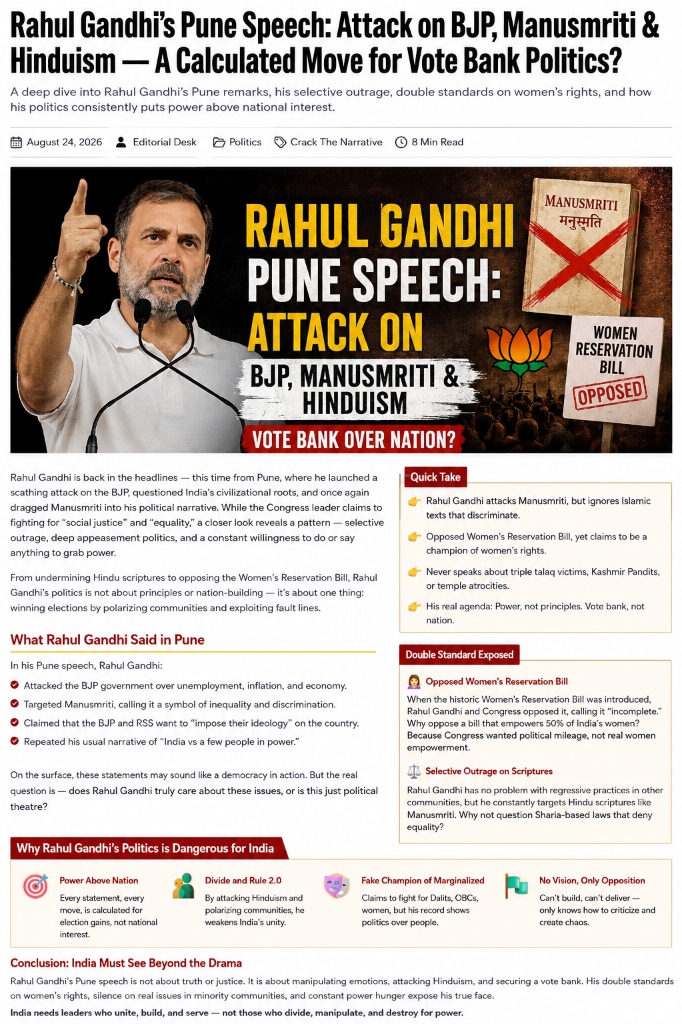
Conclusion: India Must Reject the Drama
India in the 21st century is an aspirational, self-confident civilization on the march toward becoming a leading global power (Viksit Bharat).
The electorate deserves political leaders who offer substantive economic visions, technological leadership, and social cohesion — not leaders who seek power by reopening historical wounds and dividing the citizenry by caste, creed, and region.
Rahul Gandhi’s selective outrage, deep double standards on women’s rights, and habitual denigration of Indian cultural traditions reveal a politics that prioritizes personal ambition over the national interest.
It is time for the citizens of India to see through the theatrics, demand genuine accountability, and decisively reject this manipulative agenda before it undermines the unity and progress of the nation.
Suggested Verification Sources & References
- Speech Verification: Indian National Congress Official YouTube & Speech Archives, Pune Public Gathering (August 2026).
- Legislative Acts: The Constitution (One Hundred and Sixth Amendment) Act, 2023 (Nari Shakti Vandan Adhiniyam), Ministry of Law and Justice, Government of India.
- Legal Precedents: Supreme Court of India — Shayara Bano v. Union of India (2017) 9 SCC 1; Sarla Mudgal v. Union of India (1995) 3 SCC 63.
- Constitutional Debates: Constituent Assembly of India Debates (Vol. VII, 23rd November 1948) — Dr. B.R. Ambedkar on Uniform Civil Code & Social Legislation.
Reader Perspectives